Tours
Exhibits
Support
About Us
Contact Us


Visit Exhibits Education Research Collections Support About Us Contact Us


Minerals found in Wisconsin:
Have you found a rock near your house and are not sure what it is? Have you found a fossil tooth or seashell? Here are some of Wisconsin’s more common geological offerings.

Galena (Lead Sulfide):
PbS is Wisconsin’s state mineral. It is an important source of lead and historically lots of galena was mined in southwestern Wisconsin. It usually forms silver cubes that are very heavy.


Calcite (Calcium Carbonate):
CaCO3 is a common mineral that forms clear to whitish crystals that break into rhombohedrons when freshly broken (they look like small angled boxes). An easy way to determine if you have calcite is to put a small amount of vinegar on your sample. Calcium carbonate will react with this dilute acid and will fizz.


Quartz (Silica):
SiO2 is one of the most common minerals on earth. It comes in many different colors including purple (amethyst), yellow-brown (citrine), gray to black (smoky quartz), pink (rose), and clear. Crystals of quartz are six sided, but they fracture randomly when broken.


Rocks found in Wisconsin:

Red Granite
This igneous rock contains three minerals: mica (black), feldspar (red) and quartz (clear). Red granite forms deep within the earth’s crust when hot, molten rock (magma) cools very slowly. Bigger crystals indicate that the crystals had a longer time to cool. Red granite is a popular building stone and is also used to make kitchen countertops.


Sandstone
A sedimentary rock formed from individual sand grains cemented together. Quartz sand is the most common constituent and thus sandstone will scratch glass (Limestone/Dolostone may look similar, but does not scratch glass). Most often sandstone deposits in beach and shallow marine environments and will often contain fossils.


Limestone and Dolostone

Limestone is a sedimentary rock made from calcium carbonate (CaCO3), often from the shells of microscopic organisms such as phytoplankton and foraminifera. Dolostone is similar to limestone, but also contains magnesium (Ca,Mg(CO3)2). Similar to calcite (above), limestone and dolostone will fizz when you put vinegar on them (but dolostone must be ground into a powder first). When you find this kind of rock, look closely because you may be able to find the fossils of ancient sea creatures in it!


Quartzite

Quartzite is a metamorphic rock that forms when sandstone is exposed to very high temperatures and pressures deep below the surface of the earth. All of the sand grains fuse together forming a very hard rock. Here in Wisconsin quartzite can range in color from red and purple to light pink. A good place to see quartzite is at Devils Lake, but you can probably find it closer to home. If you look at the rock underneath railroad tracks, you’re probably going to find quartzite.


Common Wisconsin Fossils:

Favosites
This is a type of coral that, like modern corals, was made up of hundreds of individual coral animals called polyps. These animals lived in large colonies, filtering food from the water. The polyps cement small calcite “cups” together, which produce the honeycomb-like appearance of the fossil. In the photo to the left, each of the circular areas would have contained one coral animal.


Horn Coral

While these fossils may look like teeth, each of these cone-shaped fossils is home to one large coral animal (polyp). These animals would sit with the pointed end of their shell buried in the ocean floor. Horn corals are described as solitary rugose corals due to the rough texture on the outside of their shells and because they did not cement themselves together in colonies.


Brachiopod: Pentamerus
Most seashell fossils from Wisconsin are brachiopods. These animals had two shells (valves) that were hinged together. The animal would stay inside the shell for protection as it filtered water for food. Brachiopods living in the ocean today are much less common and less diverse than from when Wisconsin was underwater.


Trilobite (Calymene)

Ancestors of lobsters, horseshoe crabs and bugs, trilobites are ancient animals that once crawled on the sea floor when Wisconsin was covered with a shallow ocean. Trilobites were big and small – they ranged from smaller than a thumbnail to larger than a football! As you can see in the photograph, trilobite bodies had many segments. Individual segments would often break apart either after molting or when the animal died. One specific type of trilobite, Calymene, is Wisconsin’s state fossil.


Crinoid

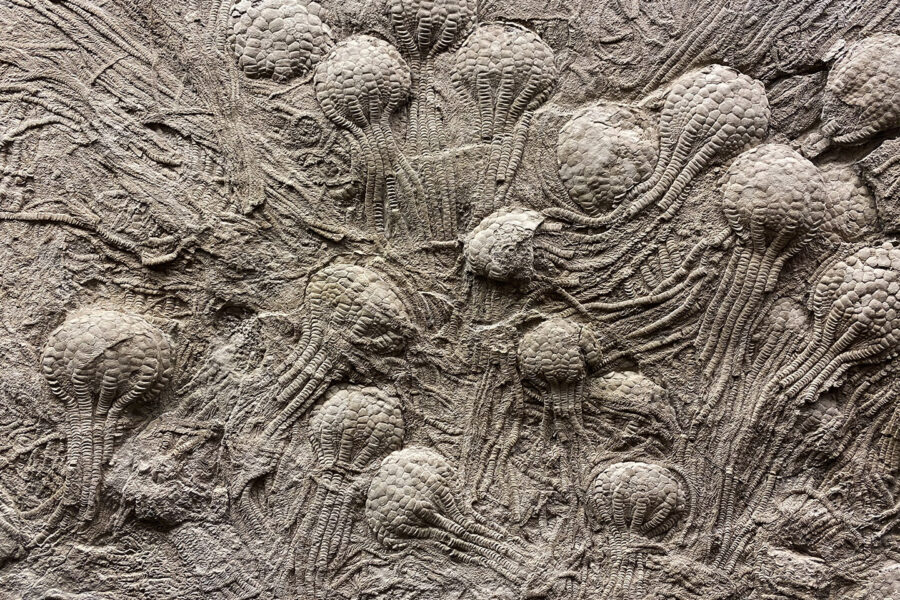
Sometimes called sea lilies, these animals are related to starfish and sea urchins. Instead of moving along the sea floor searching for food, crinoids cemented a long stalk to the bottom of the ocean and waved their long arms in the ocean currents, picking out fodd particles as the floated by. Crinoids are made of many individual calcite plates that rapidly fell apart after the animal died. These small circular plates of the stalks (that look like Cheerios) are a common fossil find.


Mastodon
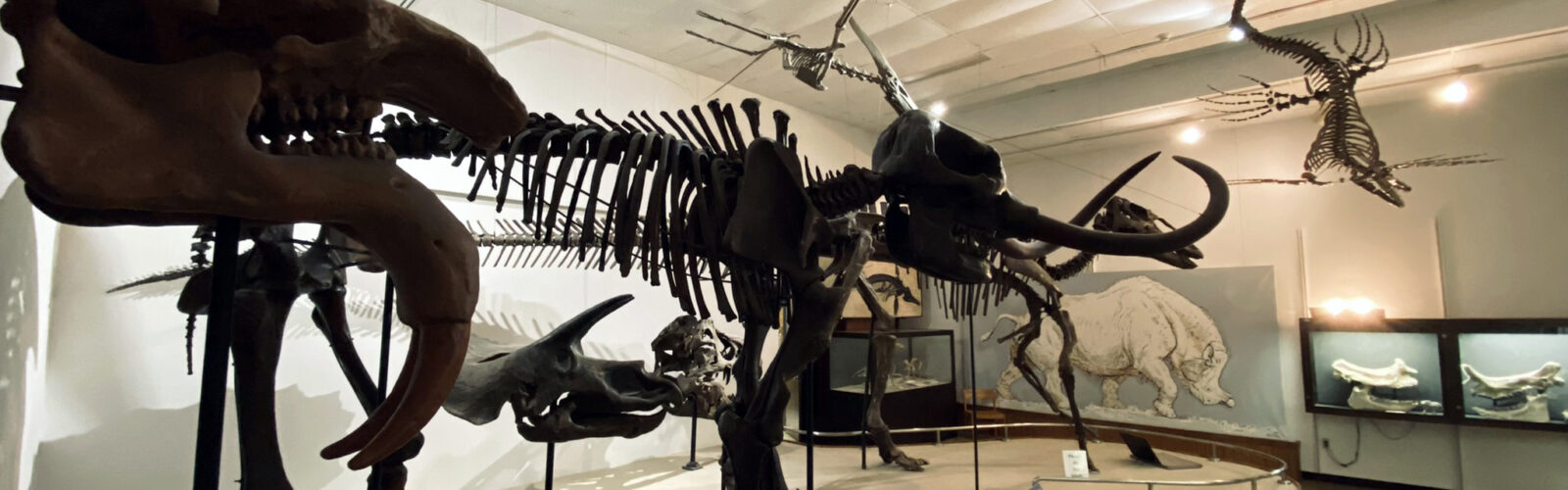
A relative of the elephant, mastodons only recently went extinct (about 10,000 years ago). Over 100 years ago, four kids on a farm near Boaz, Wisconsin found the mastodon specimen that is now on display in the Geology Museum.


Mammoth

Mastodons and mammoths look very similar, but if you look closely at their teeth you’ll notice some big differences. While they both ate only plants, they ate different kinds of plants. Mastodons have large ridges on their teeth that are good at chewing woodier plant material (twigs and branches). Mammoths have smoother teeth that could grind up grasses very well.


Giant Beaver
Also living in Wisconsin during the last Ice Age (10,000 – 12,000 BP) were beavers the size of bears! Teeth are the most common remains left by these enormous rodents. The giant beaver also went extinct about the same time as the mastodons and mammoths.


Copyright © 2005
All rights reserved.
For technical questions or assistance,
please contact museumpa@geology.wisc.edu.